
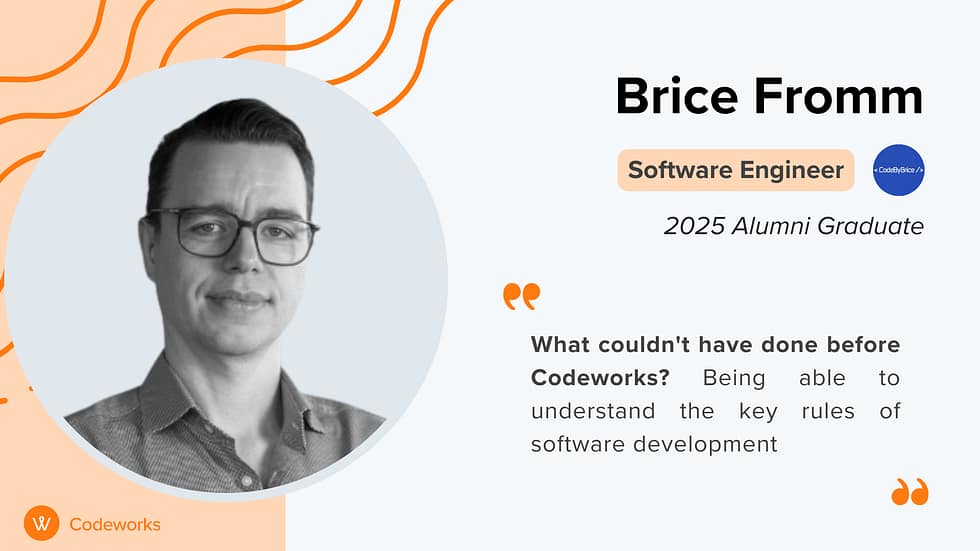
Not every Codeworks graduate ends up at a big-name company, and that’s exactly the point. Brice Fromm’s path led somewhere different: working as a freelance software developer, on his own terms, choosing his own projects. His summary of the bootcamp experience is short and honest: “It’s hard, but worth it.”
Why Some Graduate Choose Freelance Over a Full-Time Offer
Why Some Graduates Choose Freelance Over a Full-Time Offer
Brice’s decision to work as a freelance software developer rather than take a traditional employment path is worth pausing on, because it isn’t the default story we tell about bootcamp graduates. Not everyone who completes a rigorous programme wants a full-time seat inside someone else’s company, and a genuinely strong technical foundation is what makes the freelance route a viable choice rather than a risky improvisation.
The Skill Behind Every Freelance Software Developer: Reading Documentation
When asked what he can do now that he couldn’t before, Brice doesn’t point to a specific language or framework. He points to something far less glamorous, and far more important: reading documentation. “I am now used to and comfortable with reading the documentation,” he says. And when asked how the bootcamp shows up in his career today, he circles back to the same thing: “Being able to understand the key rules of software development.” This is one of the quiet, unsexy truths about what separates a real freelance software developer from someone who can copy-paste a tutorial.
Frameworks change, languages evolve, but the ability to sit down with unfamiliar documentation and figure out how something works is a durable skill, and arguably the single most useful one a freelance software developer can have when a client’s stack doesn’t match anything covered in a course.
Why Fundamentals Matter Even More For a Freelance Software Developer
For a freelance software developer, there’s no team of senior engineers sitting next door to answer questions. You are the senior engineer, the junior engineer, and the person who reads the documentation when something breaks at 11pm before a deadline. That’s exactly the kind of self-sufficiency a rigorous, immersive programme is designed to build, and it’s why Brice’s story resonates with anyone considering independence over a traditional employment path. A freelance software developer without solid fundamentals doesn’t just work slower — they take on invisible risk with every client project, because there’s no code review process to catch what they missed.
Working Indenpently, With AI as a Daily Tool
Brice now uses AI tools every day, and describes them as something that helps him go faster and better understand complicated code and principles. Notice the order there: faster and better understanding, not faster instead of understanding. That’s an important distinction for anyone considering this path today. The fear that AI will make a coding bootcamp pointless gets things backwards. For a freelance software developer working independently, the way Brice does, AI is a productivity multiplier on top of real technical judgment, not a replacement for it. Without real fundamentals, AI tools become a lot less useful, because you don’t know when the answer is wrong, and as a freelance software developer, you’re the only line of defence before a mistake reaches a paying client.
The Business Side Nobody Warns You About.
Becoming a freelance software developer isn’t only a technical transition, it’s a business one. Brice’s comfort with documentation and fundamentals didn’t just make him a better coder, it gave him the confidence to scope his own projects, estimate his own timelines, and stand behind his own technical decisions when a client pushes back. That confidence is hard to fake, and it’s exactly what a rigorous programme is trying to instil before someone goes out on their own.
Finding Clients As a Freelance Software Developer
Nobody hires a freelance software developer on potential alone — they hire on evidence. That’s why the portfolio of real projects built during an immersive bootcamp ends up mattering long after graduation: it becomes the first proof point a prospective client can actually look at. Combined with the habit of reading documentation Brice describes, that portfolio is what turns a career-changer into someone a small business or startup is willing to trust with their codebase.
What This Means If You’re Considering Independence
If part of your motivation for a career change is autonomy: working for yourself, choosing your own projects, building on your own schedule etc. Brice’s story is a useful reference point. Becoming a freelance software developer doesn’t start with freelancing platforms or portfolio hacks. It starts with the same rigorous foundation everyone else builds: reading documentation, understanding the key rules of software development, and being comfortable when the answer isn’t handed to you.
Ready to write your own story? Wondering whether this path could lead somewhere similar for you? You can also explore the full Software Engineering Immersive to learn more. You can also Book a free Intro Chat with Codeworks Admissions. A quick talk through your goals, including what independence as a freelance software developer could realistically look like.
#DevelopingFreedom